Tuesday, March 15, 2022

Saturday, March 5, 2022
Monday, February 21, 2022
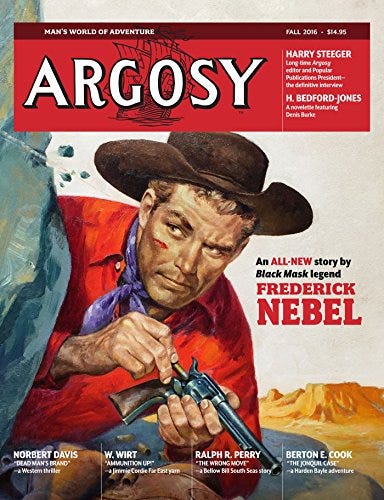
Argosy: The Father of Pulp Fiction
Originally written for the Bizarchives on 13 February 2022.
Tarzan.
John Carter.
Zorro.
Any magazine that published all three of these pulp, nay, American icons would be assured of its place in literary history. But Argosy is much more than that. Argosy is the first pulp fiction magazine, and by far one of the most prestigious of its time. With a run lasting from 1882 to 1978, Argosy set the standard for the entire field. While a general adventure magazine, Argosy dabbled in a little bit of everything, from the fantastic, science fiction, historical fiction, Westerns, war stories, and more. And whenever a genre grew popular in Argosy, some enterprising individual, such as Hugo Gernsback, would create a new genre pulp line to try to cash in its success.
Pulp fans tend to focus on the time between 1894 and 1942 as Argosy’s golden age. Prior to that time, Argosy focused mostly on children’s adventures. Soon, it faced the problem all children’s magazines faced: what happens when your audience grows too old for your stories. So Argosy retooled for a new audience: adults. And to compete, it developed a new format: the pulp magazine, printed on cheap paper.
Circulation quickly skyrocketed until in 1906, it reached a circulation of half a million copies per issue. By comparison, The Shadow at its height cleared 300,000, Amazing at science fiction’s all-time high, only 200,000, Weird Tales and Astounding averaged at 50,000, and today’s science fiction and fantasy magazines, only 5,000 per issue. Argosy’s success inspired a sister magazine, All-Story Weekly, with which it would later merge in 1920. Argosy would be sold to Popular Publications in 1942, which would spell the end of Argosy’s pulp focus, as it would begin to drift into men’s adventure before ending as an almost softcore magazine in the 1970s.

Argosy represents a merger of four magazines: the original Argosy, All-Story Weekly, Cavalier, and Railroad Man’s Magazine. The name changed often to reflect these mergers, but whether Golden Argosy, Argosy All-Story Weekly or Argosy and Railroad Man’s Magazine, the name always drifted back to Argosy. And because of the wide focus on various adventure genres, Argosy later gave birth to Famous Fantastic Mysteries, a magazine devoted to reprinting the best science fiction and fantasy stories found in Argosy. Famous Fantastic Mysteries would sit in science fiction’s Big Three throughout the 1940s alongside Astounding, Unknown, and Thrilling Wonder Stories.
But enough about history. Let’s get to the stories.
Edgar Rice Burroughs and his creations Tarzan and John Carter/Barsoom need little introduction among pulp fans. But if you are interested in strange tales in even stranger places, these stories would be the first place to start. Barsoom, alongside Ralph Milne Farley’s “The Radio Menace”, Otis Adelbert Kline’s “The Swordsman of Mars”, and Abraham Merritt’s “The Moon Pool”, represent mainstream pulp science fiction, and were the stories that inspired the creation of Amazing and later Astounding, magazines devoted solely to science fiction.
Historical adventures abounded in the pages of Argosy. The aforementioned Zorro, for one. But pulp master Max Brand, better known for his Westerns, filled Argosy with Renaissance, Musketeer, and Colonial era swordsmen such as “Clovelly”, Tizzo the Firebrand, and John Hampton, “The American” in the middle of the French Revolution. And the Three Musketeers found their match in Murray Montgomery’s rakehelly adventurers and Richelieu’s swordsmen, Cleve and d’Entreville. And back in the days of Alfred the Great, Phillip Ketchum’s “Bretwalda” would return to save England from the viking menace.
Fans of the weird would find much in Argosy to enjoy. J. U. Giesy and Junius B. Smith would popularize the occult investigator with their stories of Semi-Dual, a strange son of Persia who would solve mysteries “by dual solutions: one material, for material minds; the other occult, for those who cared to sense a deeper something back of the philosophic lessons interwoven in the narrative.” And zombie stories abounded throughout, with Theodore Roscoe penning “Z is for Zombie”, “A Grave Must be Deep”, and many other Haitian zombie stories.
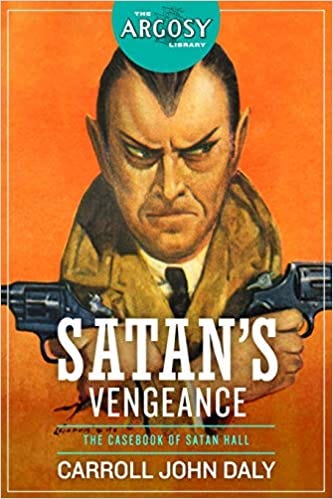
Mystery fans delighted to stories by Carroll John Daly, father of the hardboiled detective genre, including those of Satan Hall, “the cop who believes in killing criminals as they kill others.” W. C. Tuttle’s Sheriff Henry dabbled on the comedic side, as a comedic actor inherits a Western ranch—and the role of sheriff. And Norbert Davis penned his tales of sleuth Doan and his canine partner Carstairs.
Contemporary adventures abounded. Theodore Roscoe tapped into the popular French Foreign Legion genre with Thibaut Corday. Doc Savage author Lester Dent would pen a pair of comedic adventures, including “Genius Jones”. W. Wirt would raise a battalion of black WWI veterans to accompany Captain Norcross into China in “War Lord of Many Swordsmen”. Loring Brent’s radioman Peter the Brazen sailed through various intrigues in the Pacific and China.
If there is one common element tying these stories together, it is how easily most of these tales disappeared from publication, often for decades at a time. But, thanks to recent efforts, many of these once popular series are being offered once more to readers through imprints like the Argosy Library and Cirsova Classics. And although a recent attempt to revive Argosy as a quarterly fell through, there are more undiscovered gems and current writers of adventure waiting for pulp fans to find.
Tuesday, February 15, 2022
Sunday, February 13, 2022
Thursday, February 3, 2022
Perry Rhodan NEO #3: School for Mutants
“If you don’t believe in your own vision, who else is supposed to?”
 Days after Perry Rhodan invited the world to join him in the new city of Terrania, the Chinese siege intensifies, even scoring a success by shooting down Rhodan’s only spaceship, the Stardust. In an attempt to get around the Arkonide shields, General Bai Jun cuts off humanitarian aide to refugees flocking to Terrania. But the Chinese government has other ideas, and smuggles nuclear weapons into the Gobi Desert.
Meanwhile in Ireland, the mutant Sid Gonzalez is unconscious, trapped by his fears in visions of the past. John Marshall and Sue Mirafiore, with the help of other mutants such as series favorite Ras Tschubai, must dive into the young man’s mind to save him. But what they find in Sid’s past may be the key to understanding the man who now holds the Arkonide Crest da Zolral prisoner. The man who now knows why the Arkonides visited the Solar System.
Clifford Monterny.
The revisioned adventures of science fiction’s longest running hero, Perry Rhodan, continue in Perry Rhodan NEO #3 with School for Mutants by Michael Marcus Thurner and The Dark Twins by series veteran Frank Borsch. And while both novels push Perry Rhodan forward towards inevitable conflicts between his Terrania, China, and the United States deep state, the heart of each is the creation of two rival schools for mutants. One, by Homeland Security agent Clifford Monterny, who seeks to develop mutants into a sort of Hitlerjugend for Homeland Security, and the other, by wealthy billionaire Homer Adams, who seeks to marry the emerging potential of humanity to Perry Rhodan’s vision of the stars. And Sid Gonzalez, once a street urchin in Nicaragua, has at various times been in the care of both.
Flashbacks from Sid and the anti-Xavier Monterny flesh out the motives, formation, and atrocities behind the blackest of black Homeland Security projects. As a result, both men receive more characterization than Perry Rhodan himself. This does weaken the fire behind Rhodan’s vision, especially when realpolitik, ideology, and nationalism are so thoroughly condemned. And while the stars might be reason enough for people to unite under one banner, someone still has to sell that idea to people. Oddly, it is Sid’s zeal that does more for that than Rhodan’s actions. It is also as a shame, as Sid and Monterny’s flashbacks, with all the pain and grief involved, catch the reader’s attention more than the stalemate in China.
Thurner explores Sid’s trauma as the boy lives a life that’s a mix of Locke Lamora, Harry Potter, and The Promised Neverland, one that is as eventful and adventure filled as any child hero’s. Borsch tackles the harder job. European science fiction, such as Valerian and Laureline, is fond of avoiding simplistic portrayals of good and evil, and instead resorts to more a clash of differing factions. Borsch gives virtue and vice to Monterny’s creation of Homeland Security’s school for mutants, making the man’s misguided quest somewhat sympathetic. The old saw of a villain being the hero of his own story is true here. Unfortunately, the major motivator so far for all characters is pain. Not virtue, ideology, philosophy, just pain. And that fixation wears on the reader.
Allusions to The X-Men are unavoidable, although Perry Rhodan’s mutants were arguably introduced before Marvel’s heroes. Rhodan’s mutants are developments of the Campbelline fascination with psionics, and carry a high metabolic price. Sid once was a chubby teenager, for instance, before constant use of his powers turned him thin and sinewy. Other mutants are left exhausted by the use of their powers. And the refrain of ordinary people with extraordinary gifts resounds throughout both novels, as old favorites, both allies and enemies, surround Sid. At the same time, it is hard to avoid resonances with Professor Xavier and his students. Adams and Marshall combined fill a similar role to a team with analogues to Nightcrawler, Jean Grey, and others.
Perry Rhodan NEO is transitioning in these stories from Ringoesque worldbuilding to full-blown adventure. Some of this is due to consolidating a full year of the initial run into eight books. Some is also due to the initial setting mattering less, which couldn’t happen soon enough. The view ahead to 2036 looks different in these post-Corona, post-ISIS days as it did back when the European Union still mistook influence for power. But once we get to races against nuclear timers, psionic fights, and the chess match between generals, the story picks up, not just in pace, but enthusiasm. And the child protagonists of Sid and Sue provide that enthusiasm and zeal when cooler heads may dither.
As long as Perry Rhodan NEO concentrates on the stars, it soars. When the series focuses on the Earth, it stumbles. However, as long as Monterny holds Crest captive, Perry’s attentions will remain Earthbound. Fortunately, Crest is not the only Arkonide remaining, and Thora still has her part to play. Perry Rhodan will not remain shackled to mere worldly concerns for long.
Thursday, January 13, 2022
Perry Rhodan NEO #2: The Teleport and Ellert’s Visions

When last we left Perry Rhodan, the astronaut had landed in the Gobi Desert, announced the presence of the Arkonides to Earth, and invited the world to come help found the new city of Terrania. Instead of the world, a Chinese army arrives to lay siege to Rhodan and his city. As bullets fly and bombs fall around him, Crest da Zoltral’s leukemia continues to ravage his body, and the only hope of a cure requires a daring escape from Terrania and its Chinese besiegers. Meanwhile, a gangland shootout in Houston has sent John Marshall and his young mutant charges on a panicked flight across the Mexican border, pursued by police and mysterious men from the kids’ past.
As if the stakes were not high enough, Great Russia and America both send astronauts to the Moon in hopes of salvaging the ruined moonbases and making independent contact with the stranded Arkonide ship. Each expedition hides a suicide bomber with a nuclear bomb–in case the other team wins the Arkonides’ attention. If such a gameworld-addled crew might deign notice anything outside of their simulated worlds. And the world is answering Rodan’s call to join him in Terrania. A hardy mix of visionaries, zealots, and engineers are flocking to the new world-city’s banner, but crafty Chinese generals hide schemes of their own amidst these idealists.
In Perry Rhodan NEO #2, which contains the novels “The Teleporter” and “Ellert’s Visions”, these plots start weaving together into a web, as the national, commercial, and secret factions attempt to resolve the most important question of their time: who controls space now that humanity is not alone. Perry Rhodan represents an idealist globalism infatuated with the stars, the Chinese, a corrupt yet enlightened national self interest, the United States, a degenerate, hypocritical, and tyrannical nationalism, and the growing collection of mutants with esper powers, the combination of commercial and hidden factions. None yet hold the upper hand, but all threaten to bring more chaos and death to the Earth, and all are set on a collision course with Terrania.
So far, so good. Intrigue and action in exotic locations are pillars of pulp fiction. But science fiction’s infatuation with Wellsian social commentary in not restricted to English and American stories. As mentioned in previous reviews, Perry Rhodan NEO is a retelling of the original, attempting to become more relevant geopolitically and technologically than the original. This means that the story is trapped in a 2010 understanding of the world. Before COVID, before the immigration crisis, before ISIS. Before Europe started to understand the difference between influence and power. Leo Lukas is fond of repeating early 2000s jabs at America in “The Teleporter”, complete with El Norte-inspired takes on immigration and American arrogance. To say that these attempts to be relevant have curdled like milk in the wake of the turbulent 2010s would be an understatement.
But the social commentary in Perry Rhodan truly fails because it lacks vision. “The Teleporter” is a heavy-handed crack at the perceived hypocrisies of nationalism. “Ellert’s Visions” takes Arkonide gaming escapism to task. But neither posit an alternative. While Perry Rhodan is supposed to be the way out of the decadences of both alternatives, there is no vision as to why or what may inspire people to follow him. What comes across is an application of the Great Man theory and Chosen One plotting. We are given Rhodan as a model as to what we should look up to, but never an idea of what motivates him. Without a vision, the people perish–just like the Arkonides on the moon. Fortunately, the pulpy stories of alien fugitives, mutant espers, and daring space rescues shine through the thick Wellsian film.
To harp on the politics present is not to complain about the presence of politics in science fiction. After all, the chess match between Rhodan and the Chinese generals over the Gobi Desert is one of the delights of the series. Rather, the complaint is that the politics and commentary present breaks immersion, and readers will only tolerate such breaks for a limited time before abandoning the book. Perry Rhodan NEO fires on all cylinders when it comes to the intrigues and mysteries that fill its pages. It is a shame to see exposition interrupt these plots, especially when it is service to making Perry Rhodan NEO cleave closer to a “reality” that never was.
Fortunately, in Perry Rhodan NEO #3, one of the series’ best writers returns to introduce many of the original series’ most beloved characters. Whether or not readers get there depends on the tolerance for eye-rolling asides.